
Rocky Point
Boom Boom
“Things that were hard to bear are sweet to remember.” —Seneca
In November of 1973, my dear mother lay dying of cancer. She and I shared perhaps more than the average mom and son because we both had nearly died at my birth. Now, Mom properly insisted on being at home, not in a hospital. I visited with her a couple of times every day when I was not traveling.
In the early 1970s, The May Companies [TMC] were developing real estate in six states and had founded and were managing Growth Properties, a public company that invested in real estate. Professional Builder magazine listed the enterprise as the ninth largest apartment developer in the United States. TMC was a dynamic, prosperous, growing company with more than 100 employees.
Buoyed by success with developments in the Indian River and Palm Beach County sections of Florida, we commissioned several scouts to find suitable property for development. One talented broker brought us a splendid property in Stuart, Florida, with the caveat: “It needs zoning.” Zoning always has and will be a huge impediment for real estate developers. Just because a parcel meets all requirements, such as no engineering obstacles, splendid site prominence, great demand for what is proposed to be built, it does not satisfy the ability to actually construct improvements. Zoning must be in place. The ability of The May Companies to successfully change the status of a property was one factor in their success.
The unzoned waterfront property was on a spit of land on the border of the bay in Stuart, compromising a bit less than 50 acres. It was high and dry and delightfully absent major differences in elevation. Municipal utilities were in the process of extending to service the site. The asking price could be reasonable: $9,500,000. The price could be justified only if a great number of apartments could be constructed thereon. To do that, or anything in that manner, it was necessary to get it rezoned—no easy task based on past efforts in the area. Raising chrysanthemums, the major use of surrounding properties, would not justify such an astronomical price. Our proposed contract included the rezoning requirement, to be obtained at our expense, as well as all cash at closing.
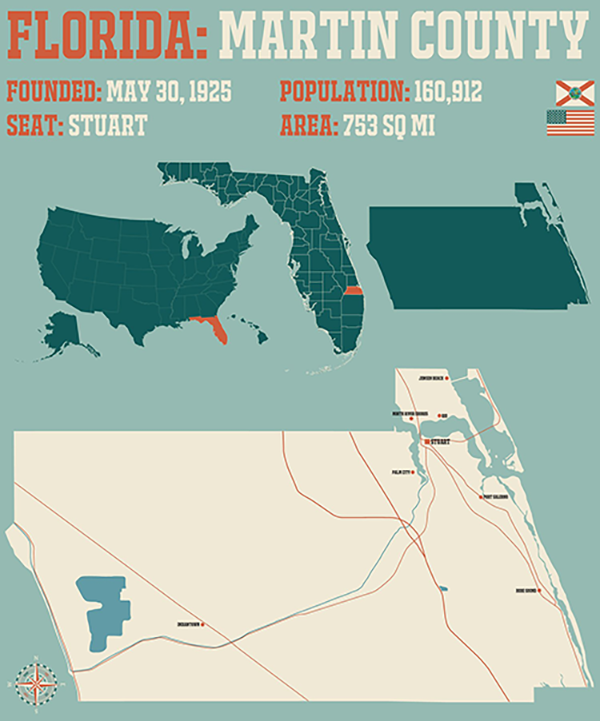
The sellers insisted on a good-faith deposit of $500,000. The May Companies, like most developers, was undercapitalized. We had the cash, mostly as operating and payroll money, but could ill afford to have it tied up for perhaps a year. I countered with what I have always thought was an inspired and ingenious proposal. We would, in lieu of cash, provide a bank letter of credit [LOC]. That was acceptable to the sellers.
Banks in those days were little like the banks of today. In some aspects, they were venture capitalists, backing new ventures and lending on future prospects as much as against financial assets. We had used LOCs to great advantage. These LOCs cost banks very little, garnered a nice cash “probably profit” in the advance fee, and banks almost never had to fund them; these served as financial guarantees, off balance sheet. However, in early 1973. the banking commission issued new rules for banks: LOCs needed to be listed as liabilities on the balance sheet.
The principal bank for The May Companies was very supportive of our business. Together we contrived to have the bank provide a letter stating that they would, on demand according to the contract, issue an LOC for the amount of the deposit stated in the contract to purchase. The sellers were satisfied, and the contract was duly executed. TMC’s cost to tie up the property was zero.
Immediately we commissioned the finest local real estate rezoning attorneys and met with the renown architectural firm that had designed the well-respected and highly successful John’s Island development nearby. Talented artists were retained to produce large-scale color drawings of our proposed project. A nationally famous firm composed a detailed and well-researched study indicating the need for the project with some emphasis on the benefits to the local economy. I personally made visits to each commissioner and detailed our plans. At the well-attended public hearing, I personally made the presentation—I obviously was not a Yankee carpetbagger, but a home-grown local builder. The rezoning was unanimous in our favor.
While we were beginning to create the final construction plans, we received an inquiry from Alcoa, the huge aluminum-producing company. The company had decided to take their great financial heft and enter the real estate development business. They liked our recently rezoned property on the waterfront in Stuart, Martin County, Florida, and wondered if we would consider selling it. As much as we liked the site, the facts were that TMC had lots of irons in the fire. I named a price that seemed to me to be substantially greater than the value of the land. To my delight and surprise, the offer was accepted, and soon a contract was executed.

On the 15th of November in 1973, the deal closed. The May Companies paid cash for the land and simultaneously sold it to Alcoa. The profit was $10,710,000. Cash. Cashier’s check. The great profit in this venture has led us to call it, forever more “Rocky Point Boom Boom.”
After the closing of the Rocky Point Boom Boom, I went by my mother’s house, accompanied by my two sons—her only grandsons—Campbell, age 7, and Geoffrey, age 3. They were dressed as for Sunday School, as was I. Her bedroom, which was light and airy, was immaculate—just the way it was always when mom could supervise it herself. Vases of fresh flowers were in abundance, sent by me. Emma Lee Fleming May was lying comfortably propped up in bed when we entered her bedroom. She was perfectly groomed, her favorite perfume Chanel #5 on her neck, and there was a happy twinkle in her eyes. She could not speak, but could hear well, understand perfectly and express emotion in her eyes. The boys and I sidled up to her bed and held the cashier’s check for $10,710,000 for her to share in this special moment. Surrounded by the family she was proud of, feeling their financial future was secure and destined for fame and glory, her eyes welled over with tears of joy streaming down her cheeks. There were no dry eyes. Emma Lee, mother, “mom-mom” seemed content and ready to go. It seemed as if the celestial chorus in Heaven was there in attendance, singing sweetly and softly in the background.
In my mind, now and forever, I can still see that scene, like a movie fade-away going up. In only a few days, my dearest mother was in the arms of the angels, never to be forgotten by those left behind. I am proud and happy that I was able to give this bit of joy to the most important woman in my life that day.
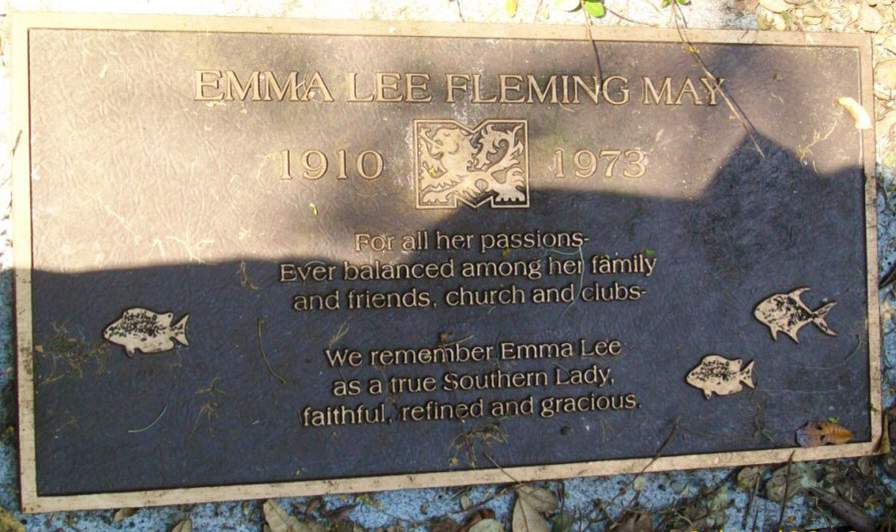
Emma Lee Fleming May (1910-1973)
For all her passions
Ever balanced among her family and friends, church and clubs
We remember Emma Lee as a true Southern Lady, faithful, refined and gracious.




Epilogue
Just a few weeks before these incidents, Egypt and Syria had attacked Israel in what became the Yom Kippur War. OPEC stopped oil shipments to the U.S. The ensuing turmoil effectively caused an economic depression, which particularly affected the real estate development community. Interest rates spiked, building commodities became scarce or non-existent and work essentially came to a halt. This precipitated The May Companies into insolvency and subsequently into bankruptcy.